
Making Sense of Physiological Signals
PhysioSense is an applied research company transforming waveform and sensor data into interpretable physiological intelligence for payers, pharma, clinical, device partners, and research organizations to detect, track, and act on physiological change earlier than conventional vital signs allow.
PhysioSense converts raw physiological waveforms into structured, interpretable intelligence.
The Intelligence Layer for Physiological Waveforms
We leverage foundational waveform science and sensor-agnostic infrastructure to provide clinical, enterprise, and research partners with a unified pathway to predictive insights.
Layer 1: Signals In
PPG, rPPG (camera), ABP, ECG — raw and multimodal sensor data from bedside, wearable, or smartphone.
Layer 2: The VascuSense Engine + SensorFusion
Patent-protected kinetic decomposition extracts high-level vascular proxies across load, compliance, reserve, timing, and coupling dimensions. SensorFusion creates higher-value multimodal embeddings.
Layer 3: Interpretable Intelligence
Explainable physiological state, trajectory, and response — not black-box scores. Continuous longitudinal tracking of vascular phenotype across clinical and programmatic contexts.
Universal Vascular Phenotyping
Mechanistic extraction of interpretable vascular proxies from pulsatile waveforms — capturing vascular load, compliance, reserve, timing, and coupling - with a clinical translation for each dimension.
SensorFusion Layer
Combines raw signals and derived physiological descriptors into higher-value fusion embeddings — optimized for risk prediction, longitudinal monitoring, real-time alerting, and integration into partner analytics platforms.
State-Space Trajectory Modeling
Patient physiological state is tracked as a continuous trajectory through an interpretable multi-dimensional space — enabling deterioration detection, treatment response monitoring, and longitudinal phenotype comparison.
From Smartphone to Clinical Platform
The same foundational waveform science powers both an enterprise-deployed member engagement platform and an advanced clinical monitoring app — demonstrating the full deployment range of PhysioSense technology.
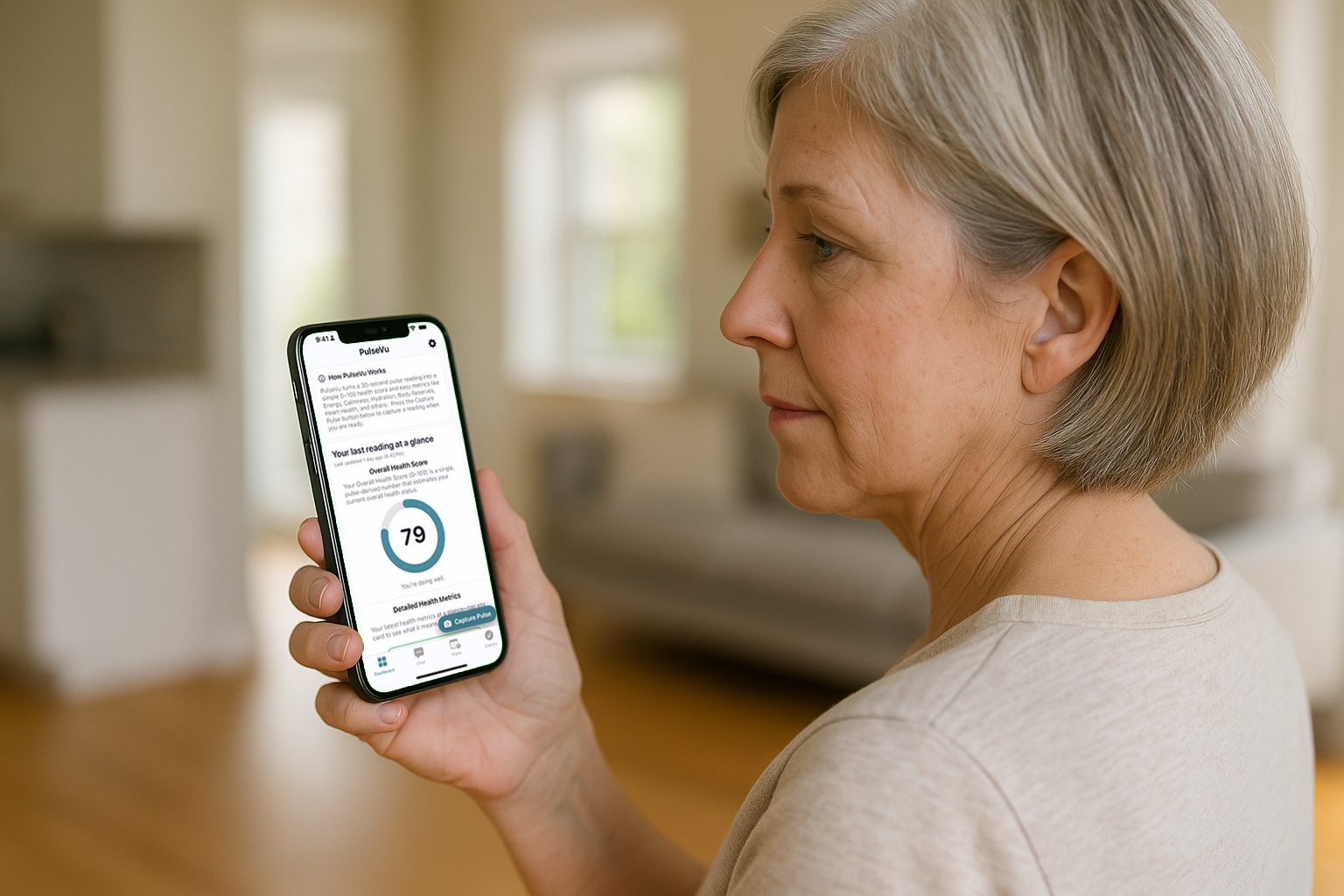
PulseVu
A 30-second smartphone pulse reading delivers an enterprise-grade physiological assessment — white-label configurable for payer member engagement, employer wellness, and care management programs.
Vascular Radar
Real-time physiological state visualization for ICU and critical care. Continuous trajectory mapping visualizes a patient's past, present, and future physiological state—identifying critical shifts before conventional vitals react.
SensorFusion REST API
Processes PPG, ECG, and ABP signals with minimal integration effort. Designed for embedding PhysioSense intelligence into partner analytics, EHR, or care management platforms.
PhysioStack SDK
Plug-and-play software stack for signal conditioning, feature extraction, and on-device physiological inference — deployable in wearable, mobile, and embedded environments.
Foundational AI Models
Pre-trained models for physiological signal interpretation across multiple modalities. Fine-tunable for partner-specific populations, clinical contexts, and proprietary signal datasets.
Evidence Across Critical Care
PhysioSense has been evaluated across multiple acute care cohorts, consistently demonstrating that non-invasive waveform-derived physiological features correlate with clinically meaningful changes — often well before conventional vital signs reflect them.
Extending into Chronic Disease, Aging & Payer Programs
Beyond acute care, PhysioSense has research addressing dementia and cognitive decline, cardiopulmonary deterioration, CHF, CKD, stroke, diabetes, and related metabolic and neurovascular physiology — creating collaborative opportunities at the intersection of longitudinal physiological monitoring, early risk identification, and enterprise payer programs.
Regulatory Status: PhysioSense technology is currently for Research Use Only (RUO). The clinical findings and physiological "signatures" described above are results from investigational studies and have not been cleared by the FDA for diagnostic or therapeutic use.
Tailored for Your Industry
PhysioSense technology adapts to the specific workflows, regulatory context, and commercial goals of each customer type. Explore the use cases, evidence, and partnership models most relevant to you.
Who We Serve
The PhysioSense platform is broad enough to serve enterprise, clinical, scientific, and translational partners — while each deployment is tailored to the specific organization's signals, workflows, and outcomes.
Health Insurers
Signal-enabled member programs, risk stratification, and proactive care management — deployed via PulseVu or embedded API.
Learn More →
Pharmaceutical
Mechanistic drug response tracking, study enrichment, patient stratification, and longitudinal physiological phenotyping for clinical programs.
Learn More →
Patient Monitoring
Next-generation waveform interpretation layers and product differentiation for ICU and hospital-grade monitoring systems.
Learn More →
Wearable Companies
Advanced physiological insights extending sensor value beyond standard vitals — vascular load, compliance, and autonomic reserve dimensions.
Learn More →
Research & Academia
Translational research models, analytics infrastructure, and collaborative programs for NIH-funded and institutional science efforts.
Learn More →
Defense & Gov't
Physiological monitoring for operational health, combat casualty care, and non-invasive field-deployable assessment programs.
Learn More →
Protected Innovation
PhysioSense holds an active patent portfolio covering its core waveform phenotyping, state estimation, hemodynamic characterization, and visualization methods — establishing defensible IP across the physiological signal interpretation space. Patent details are available to qualified partners under NDA.
IP Coverage Areas
The PhysioSense portfolio protects core methods across six distinct technology areas — spanning waveform interpretation, physiological state modeling, hemodynamic characterization, metabolic assessment, clinical visualization, and signal representation. This breadth establishes a defensible competitive moat across the physiological signal intelligence space.
Available to qualified partners. Patent details, coverage maps, and licensing terms are available under NDA for organizations evaluating strategic partnerships or technology licensing.
Deep Domain Expertise
Decades of combined experience in physiological signal processing, AI/ML, embedded systems, FDA-regulated medical device development, and translational product commercialization.


Built for Collaboration
PhysioSense can engage through multiple partnership models — each tailored to the partner's product stage, clinical context, and commercialization path. We are the explainable physiology and waveform intelligence layer within your program.
Deploy PulseVu to support population health initiatives for complex cohorts. Vascular embeddings provide additional context for longitudinal tracking, helping care teams prioritize outreach and support clinical management goals.
Non-invasive physiological phenotyping to enrich clinical trial populations, visualize physiological trends post-administration, and characterize mechanistic shifts in vascular state — particularly where waveform-derived biomarkers add precision.
Embed PhysioSense signal intelligence into existing PPG-capable devices to unlock physiological descriptors beyond heart rate and SpO2 — differentiated features that justify premium positioning and enterprise channel strategies.